
By Will Morton, Stefan Butler and Josh Pearson
from King Edward VI School for Boys, Camp Hill
James Neville Marshall was born on the 12th June 1887, to James Henry Marshall of Fermanagh, Northern Ireland, and Mary Walmsley of Southport. James was the middle child, with three sisters born before him – namely Mary Louisa, Nancy Constance and May, and a brother and sister born in the years following his birth – Dorothy and Klein. Around the time of 1892, the Marshalls move to Broad Road, Acocks Green, Solihull. At this stage, James was five years old and was about to begin his education at Wellesbourne House private school in Acocks Green.
Having excelled in Wellesbourne House, he obtained a foundation scholarship for King Edwards VI Camp Hill Grammar School for Boys, one of only four awarded each year. Perhaps because of his move to the school, the Marshall family once again move to ‘Melrose’ house on Clifton Road, a mile away from Camp Hill. Marshall continued to excel at school, and in 1899 aged 12, Marshall moved up a class placing him amongst 25 other boys aged from 10-14, with the average boy aged 11 ¾. The boys in his class were of mixed, but largely privileged upbringings, with fathers of the boys being registered as stockbrokers, skilled tradesmen, shopkeepers and commercial travellers. Marshall develops a reputation of being a strong swimmer and a ‘handy forward’ in rugby. At this point it becomes unclear as to why Marshall left school at the age of 15 in 1902.However he left with a favourable reputation as a well- rounded student, who excelled both academically and in sports – perhaps here one can see how such traits led to the gallant and brave soldier he was to become.
After leaving Camp Hill he went to work as a clerk at the Midlands Institute and then later in the Medical Faculty of Birmingham University arriving at the university in 1903. In the 1967 edition of the Medical Graduates Newsletter of Birmingham University, Dr Neville C Penrose wrote about Neville Marshall, describing him as “always happy and obliging” and “no less like a fire-eater could have imagined” – both would meet again in 1916. His obituary states that he left the university two years later to take up veterinary work, establishing a business in Harlow, Essex.
Marshall was definitely around Harlow in 1910 but what he was actually doing is far from clear, with him gaining experience and perhaps training in the treatment of animals particularly horses. However, it didn’t lead to any formal qualifications.
Marshall in 1911 moved to a large farmhouse known as the ‘Bromleys’ in the parish of Latton. It was in preparation for his marriage and to facilitate his veterinary activities, in particular his work with horses. His bride to be was Edith Taylor and they were happily married on the 20th of September 1911.
He was well liked in the Harlow community with people remembering him for his great love of sport, and active participation in the community whereby he took the Boy Scouts camping. He was also described as ‘not knowing what fear was’, and of being of Irish descent. He was a keen swimmer with it being referred to as his ‘great love’ with an assurance of a spectacular event at the gala, often involving Marshall jumping, in fancy dress, off the highest diving board. However, such joy experienced at the gala on an August bank holiday was soon to be dissipated by the outbreak of WW1 later the same year, 1914.
Everyone at the time must have known the international situation, with the heir to the Austro-Hungarian Empire, Archduke Franz Ferdinand and his wife murdered by Serbian nationals. This event and the events of the coming weeks must have cast a long shadow over any activities. On the 2nd August Germany declared war on Russia and France and initiated the Schlieffen war plan, launching a massive surprise offensive into France through neutral Belgium that would, in German theory, lead to the encirclement of Paris and the quick surrender of France before German forces turned east to defeat the numerically superior Russians. However, by launching the attack though neutral Belgium, Great Britain was propelled into action to defend Belgian neutrality and entered the war against Germany on August 4th 1914. And, thus began the First World War.
Marshall like many other young British men rushed to join the armed forces, to be a part of the war effort. Many believed the war would be over by Christmas. But this was a different war. A war of static trenches, and of attrition whereby each side made little gain at the cost of horrendous losses in men and animals. A war of innovation with new weapons like tanks, airplanes, Dreadnoughts and sadly poison gas. The war was to last over 4 years.
It has been reported that Neville attempted to join the Army Veterinary Corps at the start of the war but was unsuccessful due to being unqualified. He then made his way to Antwerp before travelling on to Malines to join the 1st Regiment of Field Artillery, which was part of the 1st Division of the Belgium Army on the 14th of September. It was whilst he was in Belgium that he was conferred by the King with the Knight of the Order of Leopold award for conspicuous bravery during the battle of Nethe. During his service with the Belgium army he was wounded three times. Unfortunately for the Belgium people Antwerp fell on 10th October with most of Belgium also being occupied. The Belgium Army, although acquitting itself well was too small to stop the Germans.
Neville was given sick leave due to injury in early 1915 returning to Harlow, after which he didn’t re-join the Belgium army, instead joining the Irish Guards in December 1915.
On 8th December 1915 Marshall joined the 2nd Battalion Irish Guards, a battalion despite its name being, according to Kipling, an extremely diverse group of men in both age and home place. With four VC and 406 medals in total between their establishment in 1900 and the end of the War, the Irish Guards were highly decorated. Between this date and February 1918 Marshall took posts on the 1st and 2nd Battalions of the Irish Guards, switching back and forth between the two units several times throughout the years. His posting as lieutenant in the Guards saw him fighting in several areas along the Western Front, most notably in the Battle of Ypres in July 1916 – a back injury at Ypres put the lieutenant out of action for seven months during which time he received medical treatment near Banbury. As a result, Marshall avoided the bloody Somme offensive of September 1916, where heavy German machine gun fire claimed many of the Irish Guards’ lives at Flers-Courcelette.
Once Marshall’s injuries had recovered sufficiently he returned to France. On 30th March 1917 he re-joined the 2nd Irish Guards, though it was some time before he saw frontline action again. At this point the battalion was assisting with railway construction work. With five wounds sustained during the war thus far, Marshall’s time in the trenches was quite limited, as it had been in the previous year following the significant injuries he received at Ypres. However, in May 1917 he joined Lancashire Fusiliers as Second in Command, with the rank of Major. Though he lost his role as second-in-command in the Fusiliers, he maintained his rank. Over the next year the Major’s role was switched between several units: again, he served with the 2nd Battalion Irish Guards from 7th-31st April 1918. Marshall once again found himself as Second-in-Command in June 1918 with the 2nd Battalion Manchester Regiment. From the battalion diary’s records, it appeared that Marshall’s rank as Major was not known to them, as some surprise was created by ‘Lieutenant J N Marshall’s appointment to the position of second-in-command’.
Marshall was renowned amongst his men for his unusually high spirits and unfailingly strong resolve to return to fight, even after the many near-crippling injuries he sustained. Though it is uncertain whether Marshall truly did receive four medals prior to the war’s opening (he claimed to have won a South African medal in 1901 when he had still been studying at King Edward’s school), the man without a doubt made quite an impression on the Western Front. Upon receiving the Military Cross after his actions in Ypres, the man could boast five medals and several injuries, giving him the image to his fellow servicemen of a seasoned veteran. His bravery was well known, described by one officer from the 42nd Lancashire division as an “almost reckless disregard for personal safety”. From the accounts provided by some of his closest colleagues on the Western Front it is clear that Marshall was almost universally admired both as an officer and as a man. His Second-in-Command in the 16th battalion Lancashire Fusiliers stated that “I have been with the battalion but a short time, but in all my military experience I have never seen such a marvellous effect of one personality on a body of men.” Such a dynamic and rallying personality was rare even on the Western Front.
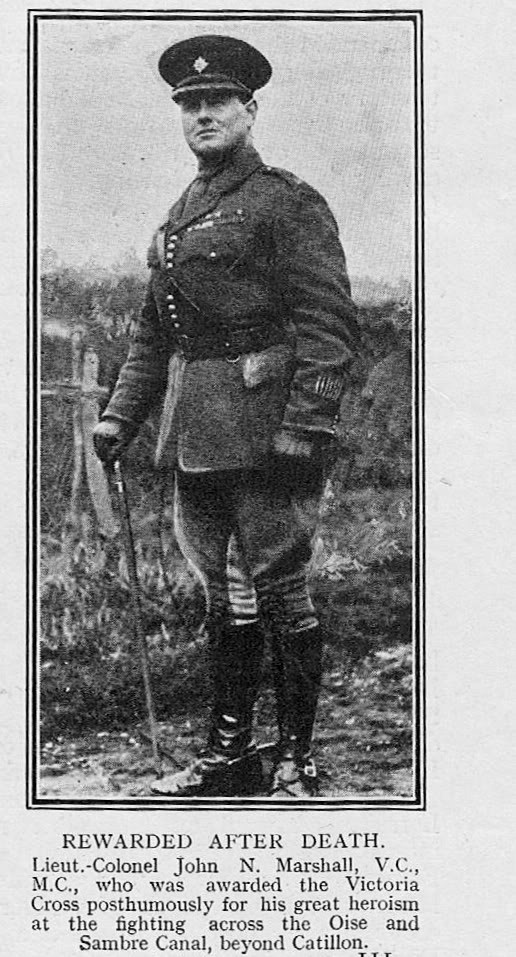
James Neville Marshall died by a shot to the head on 4th November 1918, just one week before the general armistice brought the Great War to a close. Another significant figure, the famous war poet Wilfred Owen, died on the same day, whilst involved in the very same offensive as Marshall. With the 16th Battalion Lancashire Fusiliers, Marshall was tasked with covering the Royal Engineers as they erected a new bridge to cross the Sambre-Oise Canal under German fire. With all other bridges destroyed and the canal seven feet deep the construction of the bridge was vital to a continued allied advance. As the bridge came under heavy machine gun fire, it was damaged and the now acting Lieutenant Colonel Marshall organised groups of men to repair the bridge. Marshall stood under heavy fire, encouraging and assisting with the repairs. Once repaired, he led the charge across the bridge directly into German fire. James Marshall was instantly killed at the crossing.
James Neville Marshall received his Victoria Cross posthumously when it was presented to his widow, Edith Marshall, on 12th April 1919 by King George V in Buckingham Palace. He is buried North-West of Ors, at the Ors Communal Cemetery. On his gravestone is written “Splendid is Death When thou fallest courageous Leading the onslaught,”
Afterword
James Neville Marshall was, without a doubt, a stellar example of courage, resilience and his ability to build such strong cohesion among his troops through acts such as parachuting out of a plane in drag, displaying attributes that a leader must have in order to galvanise his men, and extract every ounce of bravery and courage from within them. Not only was he a bold and noble leader, but he was the definition of tenacious. To be struck down by injury once is unfortunate, but to be injured four times and keep returning to the front is simply outstanding. Though his injuries threatened to cripple him, his resolve acted as an inspiration amongst the battalions he served with until his death. One cannot underplay Marshall’s excellence in battle. His favourable characteristics were nurtured during his time at Camp Hill and contributed to his skill on the sports field. Wherever he fought Marshall made an impression on fellow soldiers, both below and above him. He died doing what he would have continued to do had he not been fatally injured, leading his men bravely from the front, with complete disregard for his own safety, and an inner urge to succeed in battle. Marshall was an attribute to the allied army, and his noble sacrifice shall never be forgotten. Few men are awarded the Victoria Cross, and I personally believe that the VC only begins to go some way to show our gratitude for his service, and our recognition of his utmost gallantry.
“Success is not final, failure is not fatal: it is the courage to continue that counts.”
― Winston S. Churchill
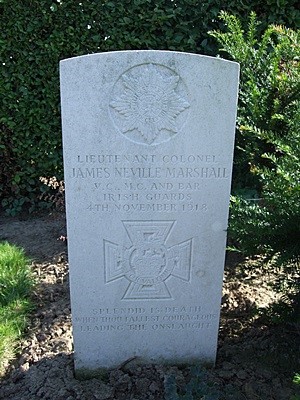
The Grave reads: “Lieutenant Colonel James Neville Marshall, V.C, M.C & Bar, Irish Guards 4th November 1918. Splendid is Death When thou fallest courageous Leading the onslaught”