
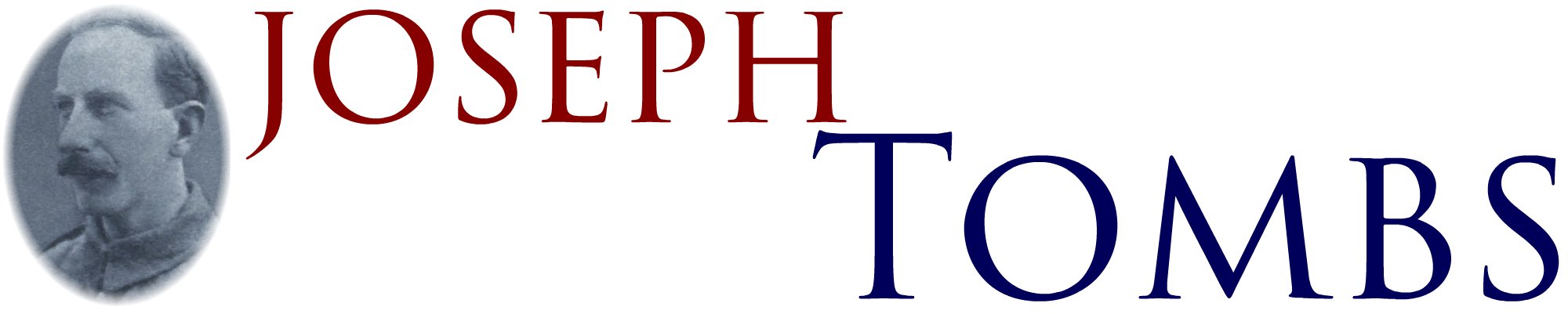
By Richard Boot
Few people will have had such a varied a life as Joseph Harcourt Tombs nor have been involved in a military role on Land, Sea and Air. An amazing story indeed.
As outlined below Joseph spent much of his later life in Canada and I have seen reference in a Canadian document looking at his illustrious life to him actually having been born in Melbourne, Australia and also on a different date to that in UK records. Clearly at some stage too he went to school in Grantham.
I will work on the basis he was born in Birmingham on 23rd March 1887 and that he went to Australia (where his parents Frederick and Mary may well have spent some time) in 1901 to live in Hobart, Tasmania. There is reference to him travelling to South America to work on Steamers, to becoming a mercenary in Peru and to working as a dredger on the Panama Canal.

After returning to the UK and on 5th March 1912 he joined B Company, 1st Battalion, the King’s (Liverpool) Regiment stationed in Warrington. Having been based for a time in Scotland the Regiment left before him and he landed in France in February 1915. Within a very short period of time he was in action and was with his comrades on 10th March when heavy casualties were incurred in a diversionary attack at Givenchy.
By the 15th May his Regiment was in action again near Rue du Bois and the Battle of Festubert with over 5,000 casualties ensued. It was here Joseph displayed his incredible bravery. Note that his citation has the date of 16th June!
The citation for his VC reads:
No. 10073 Lance-Corporal Joseph Tombs, 1st Battalion, The King’s (Liverpool Regiment). For most conspicuous gallantry near Rue du Bois, on 16th June, 1915. On his own initiative he crawled out repeatedly under a very heavy shell and machine gun fire, to bring in wounded men who were lying about 100 yards in front of our trenches. He rescued four men, one of whom he dragged back by means of a rifle sling placed round his own neck and the man’s body. This man was so severely wounded that unless he had been immediately attended to he must have died.
A witness account states ‘’ Tombs looked over the parapet of the trench for a moment as though he couldn’t quite make up his mind then he scaled the parapet and advanced through withering machine- gun fire to the body of the nearest wounded man whom he dragged back to the trenches Despite a severe shrapnel wound to his stomach, Tombs made four trips through the screaming shells and chattering machine-gun fire to pick up the wounded, some of whom he carried back on his own back or dragged to safety with his teeth’’
It should be noted that Joseph was himself badly wounded in this action yet carried on regardless! These wounds were to dog him for much of his life and he had an operation in 1952 over 35 years later to remove shrapnel fragments from his stomach.
King George V invested (the newly promoted Corporal) Tombs with the Victoria Cross at Buckingham Palace on the 12th August 1915. His grandfather, Lt Col Henry Tombs of the Bengal Artillery was also awarded a Victoria Cross during the Indian Mutiny of 1857.
After recovering from his injuries Joseph was engaged in recruiting for the Army before returning to his Battalion. In 1916, Tombs transferred to the Royal Garrison Artillery where he was assigned to an anti-aircraft battery.
He was subsequently transferred to the armed Canadian Pacific Railway ship “Minnedosa” as a gunner and left the Army in March 1920.
In 1921 Tombs emigrated to Canada where he worked for a short period with the Canadian Pacific Railway steamship line. Tombs was then employed by the Sun Life Assurance Company of Canada in Montreal from 1921 to 1939 when he was granted leave to join the Royal Canadian Air Force. He married Muriel Sylvia Gooding on 25 December 1925 and also during this time served with militia associated with the Medical Corps.
He attended several banquets for VC holders in Montreal in the late 20’s, a dinner in London given by the House of Lords in November 1929 and a banquet in May 1939 held in Montreal in honour of HM King George VI and Queen Elizabeth.
Tombs was already over 50 in 1939 when Aircraftsman Second Class Tombs signed up to join the Canadian Air Force Special Reserve. Reports say that he was assessed as a “short stocky fellow at 5ft 3 inches weighing 165 lbs. An excellent man with a distinguished record from the First World War. Good appearance, very polite, with good manners”.
Tombs explained: ‘’ I called the Recruiting Officer and told him I wanted to enlist again. The officer told me I hadn’t a chance as I was way over the age limit and that ended the conversation. Then I called a different recruiting office and asked “would you be interested in enlisting an older man with a Victoria Cross? Why certainly, let me know his name and I’ll get in touch with him.…you’re talking to him now sir! So, I signed up and here I am at RCAF Station Trenton.”
Posted initially to a training unit in Toronto his next posting in June 1940 was to RCAF Trenton where he was employed at the Central Flying School as a Disciplinarian and Drill Instructor for young aircrew. This school trained aircrew for the British Commonwealth Training Plan (BCATP) during the Second World War.
On 3 August 1941, Air Commodore HRH the Duke of Kent was conducting a tour of the facilities at RCAF Trenton and an aide to the Duke of Kent spotted the tell-tale crimson ribbon of the Victoria Cross on the uniform of Corporal Tombs. Tombs was introduced to the Duke of Kent explaining that he had received the Victoria Cross for a “bit of a thing” at Festubert, France in 1915.
Tombs was ‘honourably released’ in December 1944 as a Sergeant.
He suffered a stroke in 1964 and died on 28 June, 1966. There was a military funeral with all honours.
Joseph Tombs’ Victoria Cross and campaign medals were presented to the Royal Regiment of Canada. There has always been an alliance between the King’s Regiment and the Royal Regiment of Canada and it was agreed that the Victoria Cross should be transferred between the two regiments as a means of continuing communication.
